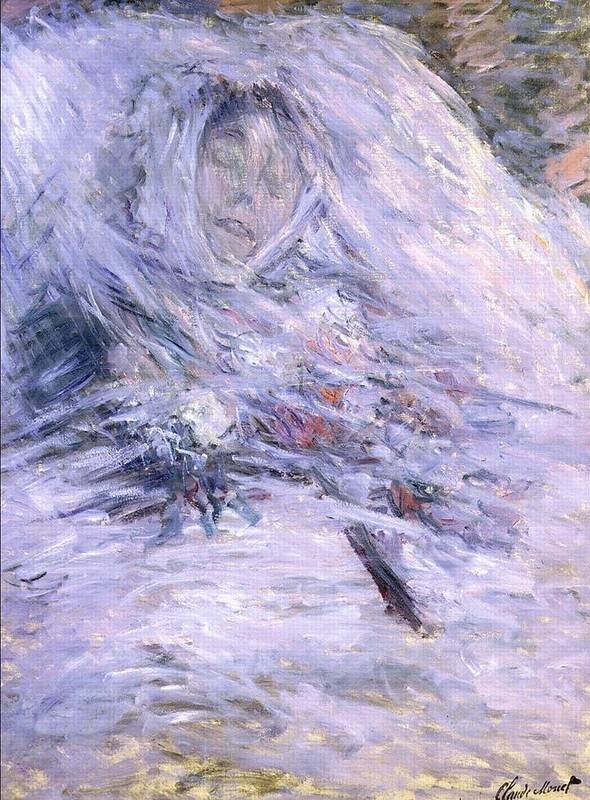
Claude Monet, Camille Monet on her deathbed, 1879
The Shrouded Woman is a novel by Chilean author María Luisa Bombal, first published in 1938. This classic work exemplifies the genre of magical realism, which blends fantastical elements with a realistic narrative, creating a dreamlike yet grounded portrayal of events. In magical realism, the extraordinary is often presented as an ordinary part of life, with little to no explanation, heightening its sense of wonder and seamless integration into reality.
The genre is predominantly shaped by Latin American authors, with figures such as Gabriel Garcia Marquez and Jorge Luis Borges at the forefront. These writers knit a Latin American identity that goes beyond the imperialist and colonial narratives, where “gender, race, and ethnicity become a united lens, not categorically separable topics that isolate non-white women from discourse” (O’Hara, 2020, p. 3), and where cultural, religious, and social themes become integral parts of the literary tradition.
In this context, María Luisa Bombal is one of the the most notable authors of magical realism in its formative years, cultivating a feminist perspective within the genre – a rejection of the colonialist ideas regarding gender in the pre-suffrage society.
The author, born in 1910 in Viña del Mar, is well regarded for her stories about women in a surrealist scene, where she explores the power structures that oppress the female sex. In works like The House of Mist (1935), Bombal’s early intersectional approach is evident as she explores the limited power of self discovery and identity in racialized women, and how the perceived inferiority of the self stems from an absurdly subjective domination rooted in the patriarchal order.
The feminocentric perspective is one of Bombal’s most prominent features regarding her writing, alongside the dreamlike nature of her works. In this article, we’ll explore these concepts within the novel The Shrouded Woman, and analyze the historical and sociological context in which it was created to develop a nuanced understanding of these themes.
Historical Context
Bombal would publish her first and most renowned novels before the approval of women’s right to vote in presidential elections in 1949, decades before the first elections including women’s votes occurred, in 1952, but right after communal level suffrage was approved in 1935.
“Anti-suffragists argued that most women did not want the vote. Because they took care of the home and children, they said women did not have time to vote or stay updated on politics. Some argued women lacked the expertise or mental capacity to offer a useful opinion about political issues. Others asserted that women’s votes would simply double the electorate; voting would cost more without adding any new value.”
(Lange, 2015)
The female role in this era was still fairly tainted by colonialist ideas, where there’s a systematic institutionalization of gender expectations that come from Eurocentric belief systems as well as norms of gendered performance (Ballestín, 2018). Colonial femininity is rooted in domesticity, portraying women in passive roles within society, while men are often depicted as active figures outside the home and family. The ideal woman embodies the Christian figure of the Virgin Mary, and as such, virginity is proposed as a prerequisite for respect and desirability. This concept is also explored in The House of Bernarda Alba by Federico Garcia Lorca (1945). Colonial womanhood also prioritizes whiteness and traditionally European perceptions of beauty.
The ideal woman is therefore a secondary member of society, oppressed under a yoke that is characterized as the natural order of things. Cultural narratives supported this exclusion by depicting women as emotional and irrational, qualities deemed incompatible with the responsibilities of voting or leadership. Religious institutions often played a role in justifying these restrictions, portraying women as moral custodians better suited for roles within the family rather than the public arena. These narratives were firmly rooted in colonial ideologies that equated femininity with submission and sacrifice rather than political participation.
By understanding the colonialist frameworks that defined femininity and womanhood, we can more deeply appreciate how texts like The Shrouded Woman use magical realism to confront and dismantle these rigid societal structures inside the Latin American womanhood scope.

One of the first female voters in Chile.
Source: La Tercera, 2024
The Book
The Shrouded Woman is a story about the recently deceased Ana Maria, who is observing from her coffin as her loved ones gather during her wake. Described as an aristocratic woman, Ana Maria is revealed to be rebellious and dissatisfied with the constraints of her era. The protagonist grapples with the acceptance of death while confronting her unresolved business, remembering the events of her life – her friends, family, and lovers.
The metaphorical and symbolic language serves to create a dialogue between the character and their own psychology.
“Now I remember. I felt like I was protected by a network of laziness and indifference; invulnerable and calm about everything other than the small ordinary daily events, like subsisting, sleeping, and eating”
The novel touches on Ana Maria’s deep dissatisfaction with her life, her frustrations, and her repressed desires. As she transitions into adulthood, the pressures of societal expectations begin to take hold. Her life becomes increasingly shaped by obligations and the need to conform to the image of the ideal woman – a passive, self-sacrificing figure defined more by her relationships than by her personal aspirations. The weight of domesticity and the suffocating limitations imposed by patriarchal structures serve as a coping mechanism for her profound unhappiness in her role as a wife. One could argue that her dissatisfaction stems from a loss of agency and control, which leads her to feeling disconnected from the vibrant, exploratory spirit of her youth that could love and hate passionately, turning into a dormant, avoidant, and disillusioned person.
Through Ana Maria’s reflections, the novel critiques a society that forces women to abandon their authentic selves to meet prescribed roles. It highlights how this conformity diminishes not only her sense of identity but also her ability to live a fulfilling life. Bombal uses Ana Maria’s inner turmoil to underscore the psychological toll of these constraints, illustrating the broader struggle of women to reconcile their individuality within the confines of societal expectations.
Her death, therefore, is in a way a liberating experience that frees her from the shackles of her sorrowful life, where she is pressured into the ideal performance of her gender, to surrender into the domestic life that society, both in the book and in real life, had put on her shoulders.
A Modern Critique
John Berger, in his book Ways of Seeing (1972), argued that in the media, men look and women see themselves being looked at. This concept stems from the male gaze and how women internalize it; these representations, therefore, permeate societal expectations and the power dynamics between men and women. As a result, women monitor their own actions as if observed by an external viewer. This power imbalance generates a mediated perception that differentiates those with agency and those who are acted upon.

Mary Stevenson Cassatt, In the Loge, 1878
This analysis of representation in the media mirrors the experience of Ana Maria during her life—from her childhood to adulthood, she lacks agency and surrounds herself with a veil of abulia. However in her death, this becomes especially obvious as she turns into the object being observed by the bystanders in her own wake. That’s where Bombal makes a difference: while it’s true that Ana Maria is being observed, she also is the observer, watching those around her. In this space between life and death, Ana Maria’s act of observation is a quiet rebellion against the forces that once led her to deep sorrows and discontent. By reclaiming her gaze, she turns from a passive participant in her own story to an active witness, asserting a form of agency that was denied to her in life.
“Respectfully dazzled, they leaned over, not knowing that she was able to see them. Because, in fact, She could both see and feel.”
As Ana Maria watches the mourners, she begins to piece together the ways in which her identity was shaped. This posthumous reflection allows her to confront the dissonance between who she was and who she might have been, had she (and those around her) not been bound by societal norms.
Although The Shrouded Woman does not explicitly address the suffrage movement, its themes resonate with the broader feminist struggles of the era. The novel was written between two milestones of Chilean women’s suffrage: the right to vote in communal and presidential elections.
Historically, because of the conflicts of gender disparity in 20th-century society, there was this common belief that women lacked the rationality to express themselves in the sociopolitical landscape. They were considered too childlike and incapable of independent thought, and therefore, couldn’t be held responsible for voting. This belief is what the suffragists fought to eradicate.
The author writes her novels during this tumultuous era for women’s rights and manages to explore the female urge for self-expression and individuality through her literary critique of the societal pressures that keep women silent.
She accomplishes this by challenging the status quo and representing the female consciousness, both profound and alert, while implicitly arguing for autonomy and foreshadowing the imminent changes in a society that urgently needs transformation.
Conclusions
Though written in a time before women had the right to vote in Chile, the novel’s insights into gender inequality and the limitations placed on women’s roles remain strikingly relevant. Bombal’s work invites us to reflect on how far we have come, and how much further we must go, in challenging the systemic structures that constrain women’s potential.
More than just a critique of gender roles, the novel transcends its historical context to pose universal questions about identity, memory, and the meaning of a life well-lived. In Ana Maria’s reflections, we are reminded of the power of introspection and the enduring importance of questioning the norms that shape our lives.
Ultimately, The Shrouded Woman serves as a haunting exploration of the ways in which societal constraints shape individual lives. Ana Maria’s journey from passivity in life to agency in death underscores the enduring struggle for autonomy and self-definition that continues to resonate with women to this day.
References
Ballestín, L. (2018) Gender as a Colonial Object. Public Seminar [accessed Nov 25th, 2024]
Lange, A. (2015) Opposition to Suffrage – History of U.S. Women’s Suffrage. National Women’s History Museum. [accessed Nov 25th, 2024]
O’Hara, A. (2020) Feminoentricism in the Magical Realist Writings of Chilean Women Authors Isabel Allende and María Luisa Bombal. COLT.

 Culterate Blog
Leave a comment