On December 17, 1903, Orville and Wilbur Wright achieved what countless dreams of but few believed possible: human flight. Their extraordinary invention, the Wright Flyer, not only redefined the boundaries of transportation but also stood as a testament to the human spirit that continually invents new ways.
The Wright Brothers
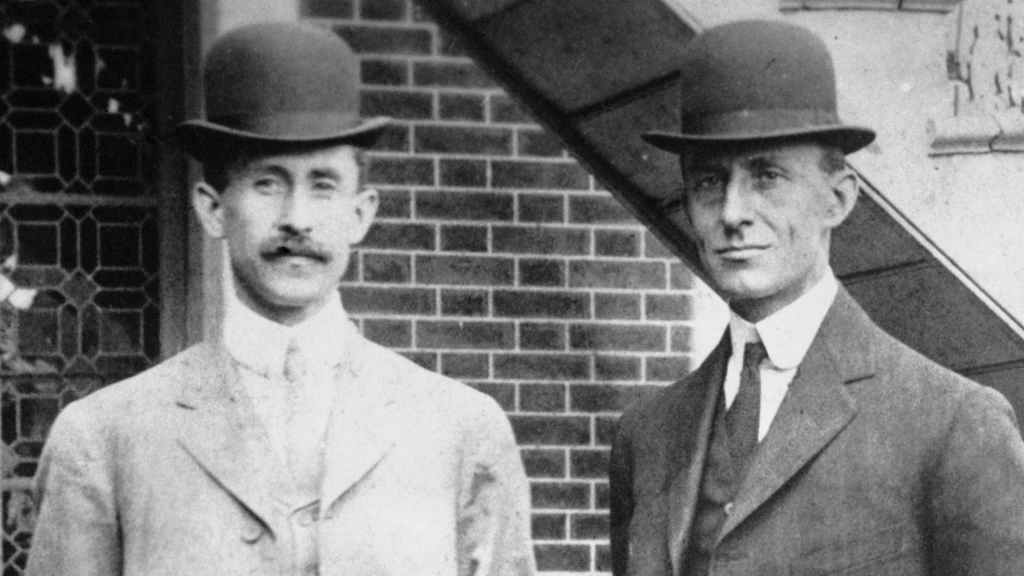
Orville (left) and Wilbur Wright
Source: History Obsessed
The Wright brothers, Orville and Wilbur, grew up in an environment that nurtured curiosity and creativity. Their father, a bishop, and their mechanically skilled mother encouraged exploration and learning. Early on, they became fascinated by science and flight, sparked by a rubber-band-powered helicopter.
Though they never finished high school, the brothers were self-taught, immersing themselves in engineering and aviation literature. They launched a printing business and later a bicycle shop, which helped them develop their mechanical skills and fund their aviation experiments. This rich upbringing laid the groundwork for their historic achievement of the first powered, controlled, and sustained flight in 1903.
The Wright Flyer
This super aircraft was a combination of scientific insight, engineering ingenuity, and boundless imagination created by two brothers whose goals reached far beyond the familiar boundaries of the world. It demonstrates the unique interplay between scientific models and complex problem-solving.
The fuselage is made of durable but weathered spruce and wrapped in finely stitched muslin, contributing to the structural integrity of the aircraft while maintaining the necessary lift. Every stitch and seam is crafted with careful attention, reflecting the Wright Brothers’ determination to achieve flight with the perfect balance of power and agility.
The Two-Wing Arrangement

Wright Flyer in the National Air and Space Museum Washington D.C.
Source: Aviation Museum
The Wright Flyer features a unique wing arrangement, detailed rigging, and a forward elevator that combines function and beauty. It visually evokes the elegance of the master’s sculptures, and the harmony of form and function that was groundbreaking for its time. This pivotal moment in aviation history was marked by many unprecedented flights, culminating in Wilbur’s astonishing 800-foot flight, which marked the beginning of a new era for human exploration.
The Wright’s Legacy
As the 20th century dawned, the world found itself on the cusp of an exciting new era, revitalized by the changes the Industrial Revolution brought about. The Wright brothers, from the small town of Dayton, Ohio, became icons of the determination that defined this revolutionary era. Their commitment to Kitty Hawk, where the aircraft was flown, was not only a personal triumph for the Wright brothers but also a statement of unity in overcoming limitations and exploring the unknown.
The Wright brothers developed their engineering ideas under the insightful guidance of George Kelly. One of their most important contributions was the creation of the revolutionary three-axis control system, which allowed pilots to control their aircraft as never before. This remarkable advancement became the foundation of aviation technology, laying the groundwork for further developments in the field. Verne and subsequent visionary film storytellers positioned the airplane as a powerful symbol of freedom and creative potential. Their stories inspired generations by encapsulating exciting ideas of endless discovery and vast worlds yet to be discovered.

Orville Wright during proving flights for the U.S. Army at Fort Myer, Virginia, in July of 1909. The Wright brothers were able to sell their airplane to the Army’s Aeronautical Division, U.S. Signal Corps.
Source: Rare Historical Photos
The final photograph of the Wright Flyer soaring high above the stormy skies of Kitty Hawk has become an icon of imagination, discovery, and art. The brothers’ incredible journey reveals a deep sense of experimentation and positivity, showing us how challenges once thought insurmountable are overcome. In recognition of their unique contribution to aviation and our understanding of flight, we celebrate not only the technical prowess of airplanes, but also the inexhaustible power of man to think, innovate, and push our boundaries.
 Culterate Blog
Leave a comment