
Thinking about fashion in the current year is inevitably thinking at a glocal scale. The interconnected world allows us to obtain and often repurpose material culture from around the world in order to adapt to our local needs as consumers.
When I see my closet, I usually encounter thrifted pieces that come from Germany or the United States, prints that showcase texts I cannot read since they are in a language I don’t understand, and sometimes, at a smaller scale, I find a pair of earrings made locally.
Yes, the fashion industry is an organized mess—a cultural melting pot that cultivates narratives from international stories at the doorstep of even the most remote lands. But this practice of merging global and local markets in fashion is a tale as old as time. Just as society itself evolves, fashion builds layers of meaning sourced from every experience we encounter as humans, bringing both opportunities and challenges.
But what is glocalization and how does it affect fashion? In short terms, glocalization in fashion is the merging of global fashion identities with local cultures. It is a step further from globalization, which speaks of the interconnected globe (hence the name). Glocalization is a concept that was introduced formally in scientific circles, by theorists such as Roland Robertson, and it speaks of an entity that encapsulates both the global and the local alike.
Historically, the roots of glocalization in fashion can be traced back to early human interactions, where ideas from various cultures were adapted to meet the social norms of specific localities. However, for practical purposes, this article focuses on the glocality of fashion in the well-documented 20th century, as it was the one era responsible for moving large-scale globalization efforts that facilitated significant cultural exchange, owing to the rapid advancements in communication and travel. The influence of identity hybridization, along with the ongoing duality of tradition and modernity, continues to shape our understanding and participation in fashion systems to this day.
Early 20th Century: Colonialism and Cultural Closeting
The early 20th century was heavily influenced by colonialism, with European powers exerting control over economies, even in regions with self-governance. This legacy continued to shape the politics of former colonies, often resulting in a cultural identity that admired and emulated European body ideals and dress trends. Oddly enough, colonial exploitation also led to the monopolization and exploitation of resources from colonized countries. Notably, this exploitation fueled the appropriation of patterns, materials, and designs for European sartorial trends. The colonization of India under British rule is a prime example, where Indian textiles became prized luxury items in Europe, marketed for their exoticism and status symbol. This was not the only phenomenon, as other foreign textiles, such as silk, remained highly sought after during this period.
On the other hand, the effects of colonialism on clothing can be seen in Native American communities, where people often adopted the colonialists’ perceptions of propriety by dressing according to societal norms established in the United States. The same natives that Cortés described as dressed in rich and varied clothing are now being ridiculed as nude and therefore savage, while their jewelry and textiles are exposed in museums.
Speaking of savage, animal prints would take a strong hold of fashion in the 1930, whereas fur had long been associated with aristocracy in Europe—especially highlighted by Napoleon’s travels to North Africa. Prints featuring exotic creatures like leopards and zebras became mainstream in European and American apparel, largely due to the cultural phenomenon of the movie Tarzan the Ape Man (1932). These inspirations were taken from colonized lands, just as Asian prints were in earlier decades, adapting them to the fashion and dressing styles of the era.
As World War II unfolded, both colonialists and imperialists sought to weaponize fashion as a means of expressing patriotic sentiments through dress. Japan, for instance, used the kimono to imprint propaganda and nationalistic ideals embedded in the textiles from which they were made. Meanwhile, European countries adopted a more utilitarian approach to fashion, moving away from the extravagance of previous decades. This shift favored slimmer silhouettes and shorter hemlines, added to the attempts of making the wardrobes—in particular the female closets—more patriotic and less influenced by international material culture.
A good example of this is the United States, utilizing the color red in lipsticks to instill patriotic ideals into the everyday woman.

Mid 1930s zebra print
Source: fitnyc
Mid-20th Century: Post-War Globalization
As World War II came to an end and the Cold War unfolded, intentional globalization efforts emerged, driven by the expansion of capitalism and technological advancements. With the development of technologies also comes the creation of new communication methods, interconnecting diverse regions of the globe. This was a natural aspect of the cultural and technological conflict that characterized the divide between the opposing blocs in the world. This acceleration also came with the easier access to international travel, which resulted in an increased contact with once remote areas.
As capitalism grew, a more standardized sense of fashion began to take place, considering that culture as a whole started to be more and more influenced by American values through the media. In turn, this bridged hybridity in the first and third world.
During this time, fashion became increasingly democratized as ready-to-wear clothing gained popularity, thanks in part to designers like Yves Saint Laurent, who bridged the elegance of haute couture with the practicality of streetwear. It was also further supported by the ever-growing industrialization and the resulting mass production of clothing items.
This democratization of fashion enabled local brands like Levi’s to export their influence globally, transforming jeans into a staple of sartorial choices worldwide and allowing this textile to reach distant lands from Japan to Argentina.
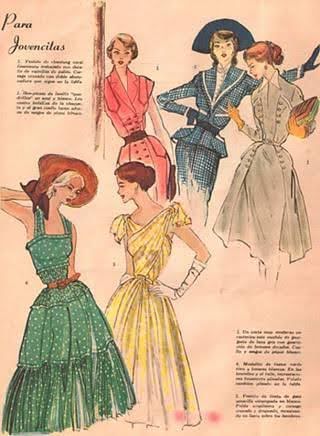
Argentine fashion inspired by Dior’s new look, 1951
Source: picryl
Late 20th Century: The Explosion of Subcultural and Ethnic Fusion
While in earlier eras fashion was mostly dominated by the elegant, during the 1960s we encountered a cultural shift: fashion became less about imitating the wealthy or formal, but more about the hip and cool.
The youth spearheaded these “cool” movements, using subcultures as a means to forge social identities in a world that permitted rebellion through lifestyle and fashion.
These new subcultures embraced foreign fashion elements and accessories to create a countercultural discourse through dress; the hippies of the 1960s incorporated Indian tunics, African beads, and tie-dye techniques, reflecting a yearning for authenticity in an increasingly industrialized world. Similarly, the punk movement of the 1970s, while rooted in Western discontent, drew inspiration from global aesthetics, including tartan fabrics from Scotland and Japanese avant-garde influences. Fashion was no longer just about clothing, it became a manifesto of counterculture.
On the same branch, music and other cultural manifestations worldwide were utilized as a way to justify the exploration of different fashion trends, just like reggae permitted the adoption of rastafarian elements in clothing.
Brand growth flourished in an increasingly globalized world, opening new markets within the fashion cycle. It began with haute luxury brands offering avant-garde designs that pushed boundaries in pursuit of the latest trends. These high-end styles influenced the production and design of everyday clothing in more affordable fashion brands. As locals in the first world embraced these trends, they began to dictate fashion direction, which in turn impacted the third world. In many cases, new products inspired by first-world trends emerged, or used clothing from affluent nations was distributed to consumers in the global south. A good example of this is the concept of “ropa americana” or American clothing, popularized in Chile by the early 1980s, where leftover clothes would be shipped to the country from the United States to be sold and redistributed in thrift stores. Conversely, fashion houses took inspiration and appropriated elements from other cultures to generate new trends in the first world, like in the 90s where there was an important usage of Asian articles and inspired prints, like the Cheongsam as an everyday dress and chopsticks as hair decor, also known as chinoiserie.
As the 20th century ends, the world is rapidly becoming increasingly globalized and so does the fashion industry.

Rachel Green from “Friends” wearing a Cheongsam
Conclusions
The 20th century may have ended a few decades ago, but as the world becomes more glocalized, one can’t help but reflect on how its impact continues to shape our understanding and practice of fashion, often influenced by outdated systems. As previously mentioned, fashion is a melting pot of multiple styles and cultures that converge to create the new.
Glocalized fashion is a symbol of interconnectedness, becoming increasingly apparent as social media fosters the constant birth of new trends that spread across the globe with just a few clicks.
It’s not as relevant for this article to feed the debate of cultural appreciation and appropriation, rather showcasing the duality of fashion in these same regards. Fashion both takes and creates, imitates and innovates. Even so, it’s important that we discuss the ethical practices currently being developed within the fashion industry. We must consider how far we’ve come or how little progress has been made, and how our clothing choices are not made in a vacuum; rather, they result from a long process of adaptation within the context of an evolving glocalized world.
References
Roudometof, V. (2016). Glocalization, a critical introduction. Routledge.
Molenaar, C. (n. d.). Fashion and colonialism: a case study of India. Threading change.
Retana, C. (2009). Las artimañas de la moda: la ética colonial/imperial y sus vínculos con el vestido moderno. Revista De Filosofía De La Universidad De Costa Rica, 47(122), 87-96.
(n. d.). Saint Laurent river gauche. Musée Yves Saint Laurent Paris.
(n. d.) Obra ropa americana. Paz Errazuriz.Yong, S. (August 4, 2017). Are we really doing this whole Asian cultural appropriation fashion trend again?. Allure.

 Culterate Blog
Leave a comment