A rising voice in contemporary literature, sixteen-year-old Polish author Claudia Wysocky speaks about her journey in crafting psychological thrillers, her latest work, and the universal language of storytelling.

Claudia Wysocky, a Polish writer and poet based in New York, is known for her diverse literary creations, including fiction and poetry. Her poems, such as “Stargazing Love” and “Heaven and Hell,” reflect her ability to capture the beauty of life through rich descriptions. Besides poetry, she authored “All Up in Smoke,” published by Anxiety Press. With over five years of writing experience, Claudia’s work has been featured in local newspapers, magazines, and literary journals including WordCityLit and Lothlorien Poetry Journal. Her writing is powered by her belief in art’s potential to inspire positive change. Claudia also shares her personal journey and love for writing on her own blog, and she expresses her literary talent as an immigrant raised in post-communism Poland.
Your current project “The Satisfaction of the Writer” takes a critical look at the writing industry. What inspired this theme?
“As a young author myself, I’ve definitely experienced my fair share of rejection and doubt,” Claudia begins. “The idea came from the frustration and solitude that can come with being a writer. Mateo’s character is loosely based on myself, exaggerated for dramatic effect.”
She explains that the theme of struggling to find one’s voice resonated deeply with her. “The world often isn’t kind to those who think differently, and Mateo’s situation reflects that. His desperate attempts to prove his sanity mirror the challenges many artists face when trying to convince others of their passion’s validity.”
As a 16-year–old author specializing in psychological thrillers, what unique challenges and advantages have you found?
“My age allows me to tap into the angst and turmoil that comes with adolescence,” Claudia reflects. “I can relate to the feelings of isolation and loneliness that some teenagers experience, making it easier to understand and portray my characters’ mindsets.”
However, she acknowledges the limitations: “My age sometimes becomes a disadvantage when it comes to life experiences. I haven’t experienced everything my characters have, so I have to rely on research and observation to create believable storylines.”
Her approach to crafting suspense is methodical: “I leave hints and clues for the reader without giving away too much too soon. I create detailed backstories for each main character, even if those details never make it into the final draft. This practice helps me understand their motivations and how they’ll react in certain situations.”
You’ve mentioned having five finished books. How has your writing evolved?
“The Satisfaction of the Writer is my sixth full-length novel, and I can confidently say that my storytelling abilities have improved leaps and bounds,” Claudia shares. She points to specific areas of growth: “My prose has become more refined and concise. In my earlier works, I had a tendency to overwrite and include too many adjectives and adverbs, which weighed down the narrative.”
She’s particularly proud of her character development: “My early works had fairly two-dimensional characters. They were either good or bad with little nuance. Now, I’ve learned the importance of creating complex, multi-dimensional characters with believable motivations.”
Your work spans multiple genres. How does your creative process differ between them?
“Historical romance requires more research and attention to detail than my other works to ensure accuracy,” Claudia explains. “Psychological thrillers require me to delve deep into the darkest recesses of my mind, which can be emotionally draining but also rewarding when done right.”
Poetry holds a special place in her creative process: “It’s more cathartic and therapeutic for me than any other genre. With poetry, I can explore my own emotions and thoughts without worrying about plot or character development.”
How does your Polish cultural background influence your storytelling?
“Poland has a rich literary tradition,” Claudia notes. “Authors like Kafka, Gombrowicz, and Dostoevsky have shaped my storytelling sensibilities, instilling in me a love for the absurd and the psychological.”
She finds that certain themes transcend borders: “Loneliness and existential angst are universal human experiences, so I’m heartened to learn that my stories resonate with readers from all walks of life.”
What advice would you give to other teenage writers?
Claudia’s response is immediate and passionate: “Just start writing and don’t worry too much about perfection. The fear of not being good enough or not measuring up to others can be paralyzing, but the truth is, everyone has to start somewhere.”
She emphasizes the importance of perseverance: “Rejections are part and parcel of any writer’s life, but it’s how you bounce back that counts. Above all else, remember why you started writing in the first place: because you have a story to tell and a passion for words.”
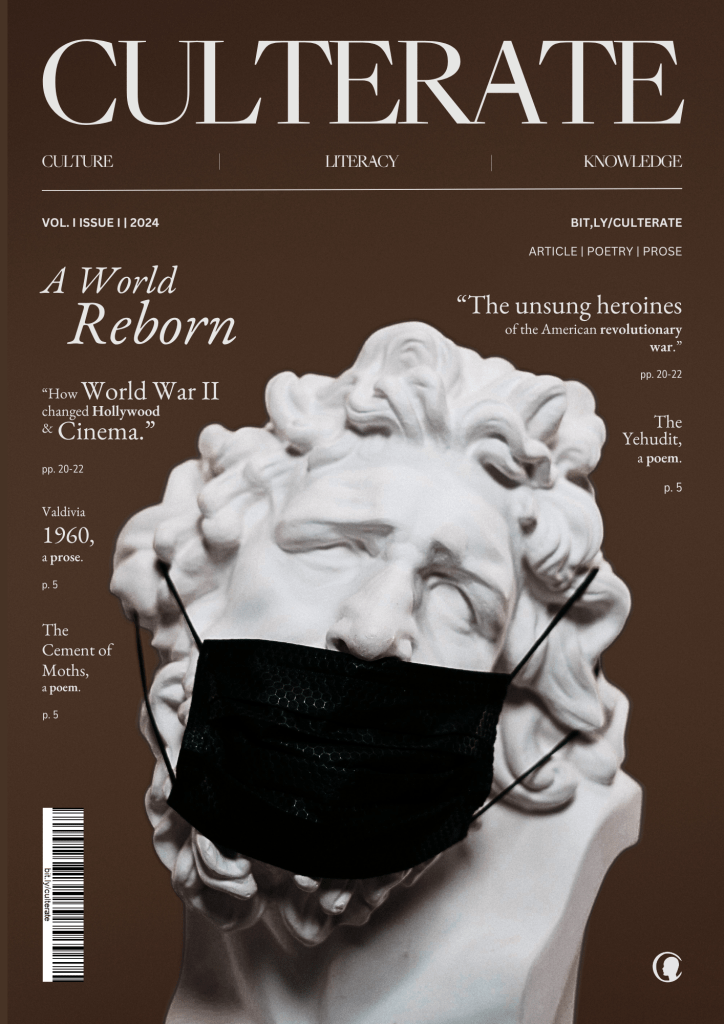
Read Unfinished Exit in Culterate’s Issue I: A World Reborn
Claudia’s latest work “Unfinished Exit” explores the complexities of loss and absence, particularly in the context of suicide and its lingering impact. Through metaphorical mapping and missing person’s posters, she crafts a narrative about the impermanence of existence while holding space for reclamation and reinvention.

Refilwe Queen M.
INTERVIEWER
Refilwe Queen M. is a passionate freelance writer dedicated to exploring the complexities of human existence through her work. She brings a fresh perspective to storytelling, blending creativity with thoughtful analysis to create content that engages and inspires. Driven by an insatiable curiosity, Refilwe seeks to uncover new ideas and share insights that encourage others to think deeply and live authentically.
 Culterate Blog
Leave a comment