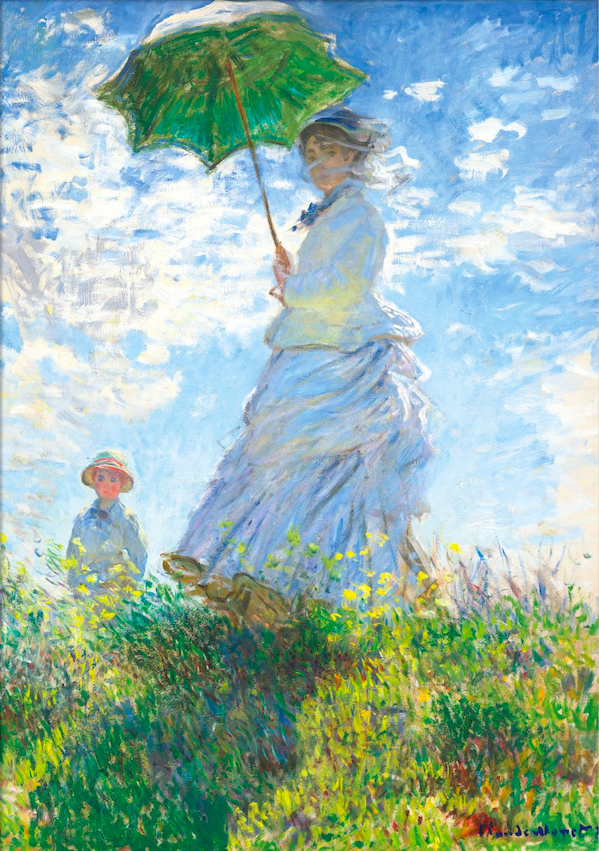
Woman with Parasol, Monet (1875)
The Life of Impressionism’s Master
Claude Monet, born in 1840, was a French painter who became one of the most significant figures of the Impressionist movement. His childhood was relatively simple; growing up next to the port of Le Havre in Normandy, he was passionate about being an artist from a young age.
Monet was fortunate to have the support of his aunt, Marie-Janne Lacadre, who also loved painting and encouraged him to pursue his artistic dreams. By the age of 15, he was already known in his neighborhood for painting portraits of famous personalities.
Inspired by the engravings of Japanese artist Hokusai and the works of Eugène Boudin, Monet was introduced to new techniques involving light and color. From that point on, he began to study these elements in nature, leading him to become a landscape painter—a choice that was quite uncommon for artists in the 19th century.
However, Monet’s artistic journey was interrupted when he had to serve in the military. He spent time in Algeria before returning to his artistic pursuits in 1862 by resuming his studies. It was during this period that he met fellow artists Auguste Renoir, Frédéric Bazille, and Alfred Sisley. Living a nomadic life, Monet faced many difficulties, despite the success of his piece “The Balcony by the Sea Near Le Havre” and a portrait of his lover, Camille Doncieux.
In the summer of 1869, Monet and Renoir gathered in a small community near the Seine River, where they painted canvases that would later be considered some of the earliest examples of Impressionism.
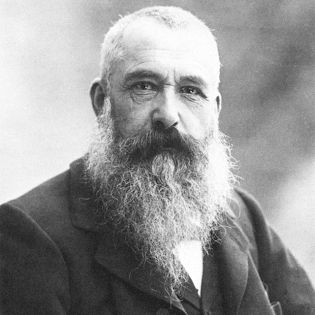
The Impressionist Movement
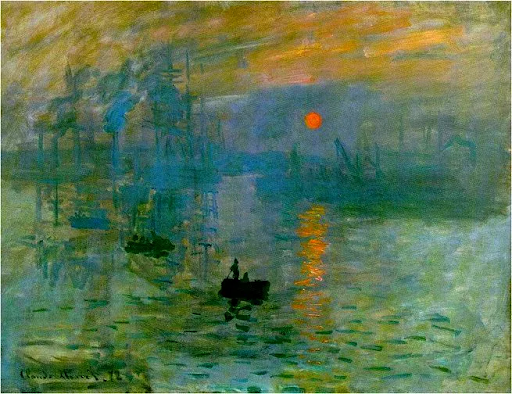
Impression, sunrise, Monet (1872)
Impressionism was an artistic movement that gained momentum through painters who sought to challenge the traditional rules of the art world. Claude Monet was a pioneer of this movement, alongside other artists who strayed from creating realistic representations of life.
During this time, realism was still a popular art style, centered around depicting life as it truly is, rather than how we perceive or wish it to be. Impressionist painters challenged these ideals by creating works that reflected their own perceptions of nature and everyday life, often reflecting innovative approaches to religious themes and landscapes.
Less traditional and more subjective, Impressionism captured objects, landscapes, and people in unique ways. While the subjects might appear simple, the techniques used to create these images were anything but straightforward.
Monet and his contemporaries employed “quick brushstrokes,” often applying what appeared to be an “exaggerated amount of paint.” Key characteristics of Impressionist paintings include the use of neutral and sometimes muddied colors, along with a deliberate avoidance of shadows in shades of gray and black.
When examining Monet’s works, one might notice that shapes and lines often lack sharp definition, resulting in a delicate yet rustic quality. This choice of a neutral color palette contributes to the delicacy, while the thick brushstrokes and generous application of paint imbue the scenes with a sense of earthy authenticity.
Nature and life as one
Gardens, lakes, trees, forests, skies, and flowers—all elements of nature—were vividly portrayed in Impressionist paintings, with Monet being a significant influence from the very beginning.
Initially, painters worked on their pieces outdoors, highly valuing natural light and drawing inspiration from the landscapes surrounding them. Beautiful scenes, such as leaves dancing in the wind and lakes reflecting the colors of sunrise and sunset, motivated them to create their own interpretations of gardens and lakes.
As a result, color and light played a crucial role in their work. Monet, in particular, opted not to mix his colors; instead, he applied them directly to the canvas. This technique allowed him to create not just a picture but also a sensory experience for the viewer.
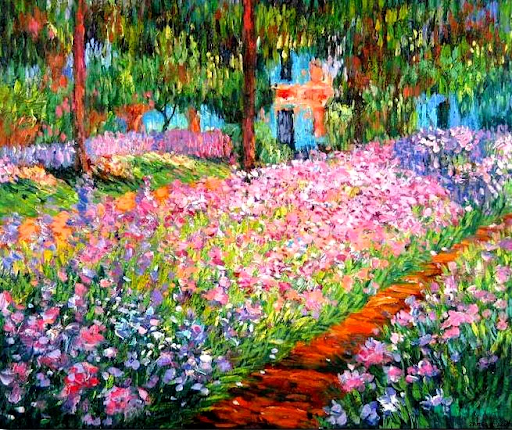
The Givenchy Garden, Monet (1883)
Living in a turbulent time marked by significant technological transformation, Monet often left his studios in the city to explore the fields and the vibrant, colorful landscapes surrounding him. He believed that paintings should capture the fleeting reflection of natural light at a specific moment, always mindful that the colors of nature change daily with the intensity of sunlight.
Every detail mattered to Monet, as he was one of the first painters to connect life, nature, and art, seamlessly merging these three elements in his work. The landscapes held personal significance for him; observing and painting them was what finally made Monet feel whole and led him to embark on his artistic career.
Today, his paintings evoke a sense of “interior peace,” offering a glimpse of simplicity, serenity, and tranquility.
Claude Monet’s legacy is that art is part of life and ourselves
Claude Monet faced financial challenges throughout his life, despite some successes in his exhibitions. In 1874, he rented a house where he not only painted flowers but also planted and grew them in his own garden alongside his lover, Camille.
In 1878, after moving to Vétheuil, Monet created approximately 150 paintings. This year was significant for him as his son, Michel, was born, but he also tragically lost Camille just a year later, which prompted him to relocate once more.
In the later years of his life, Monet moved back near the Seine River, where he married Alice Hoschedé, who had six children from her previous marriage. He continued to paint during this time, producing one of his most renowned works, “The Gardens at Giverny.”
As he aged, Monet began to lose his vision due to cataracts, a condition exacerbated by his extensive time spent painting outdoors in bright sunlight. At that time, eye surgeries were not as advanced as they are today, yet Monet remained committed to his painting.
He did eventually undergo surgery; however, it was pulmonary cancer that ultimately led to Claude Monet’s passing. Today, he is celebrated as a symbol of Impressionist art. Monet embodies the idea that subjectivity and simplicity are perspectives we should never abandon.
Observing life from a natural point of view can heal us and instill a sense of completeness and happiness, making us feel connected to something greater—an integral part of the painting we create ourselves.

Moara Flausino
AUTHOR
Moara is a journalism student from Brazil with a passion for literature, poetry, and art. Since 2021, she has been working in writing and content creation, and she has two poems published in anthology books of poetry. Learning new things excites her, and she believes that embracing different forms of writing and expression is always inspiring. Her goal is to write as many stories as she can, sharing their uniqueness with the world.
 Culterate Blog
Leave a comment