
Want to know what’s coming in your near future? What feelings does he have for you? Why is your present the way it seems? Tarot might have some answers.
Divination tools are nothing new, for thousands of years the human race has tried to discover what’s coming, and, as a tarot reader myself I have also found the wonderful world of tarot as a reflection of the inner self through symbology.
Regardless of whether you believe tarot to be real, it cannot be denied that tarot is a form of artistic expression. Different decks take the basic iconography of tarot cards and reinvent them for interpretative purposes.
In this entry, we’ll be exploring the iconography of tarot across different artistic styles and how multiple decks manage to reinterpret the meanings behind arcana using new and unique symbols.
But first, a bit of history.
The Origins of Tarot as Art
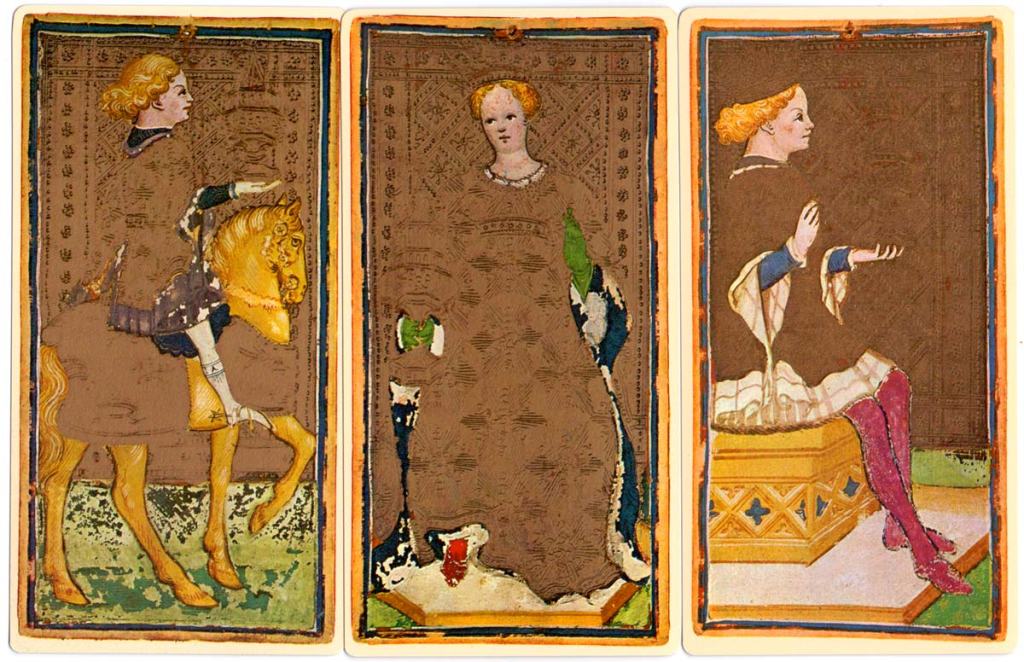
Cards from the facsimile edition of “I Tarocchi dei Visconti” published by Dal Negro, Treviso, Italy.
The earliest signs of tarot can be traced back to 15th-century Europe, specifically northern Italy, where the Visconti-Sforza cards were introduced in courts as a deck of playing cards. This deck consisted of 56 cards divided into suits, along with a wild card and 21 trump cards.
The earliest signs of tarot can be traced back to 15th-century Europe, specifically northern Italy, where the Visconti-Sforza cards were introduced in courts as a deck of playing cards. This deck consisted of 56 cards divided into suits, along with a wild card and 21 trump cards. The original deck was made for Filippo Maria Visconti, duke of Milan, closely followed by a deck made for his son-in-law, Francesco Sforza, making what’s known as the Visconti-Sforza tarot.
These decks were made before tarot cards were standardized the way they are known today, as the Visconti deck included faith, hope, and charity. Virtues which we don’t see nowadays.
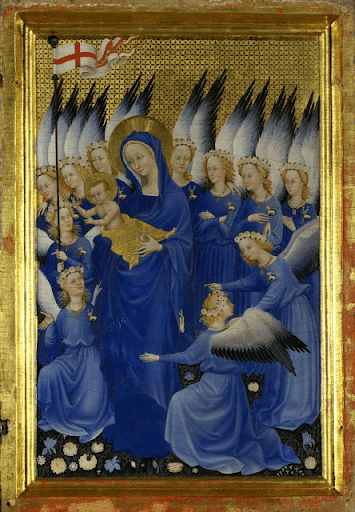
Medieval and Renaissance religious art were a clear influence in the creation of the Visconti-Sforza cards. This influence is evident in both the artistic style and the use of color, which reflects the Byzantine elements commonly found in European church art, including the round elongated faces and the prominent use of gold.
These original sets of cards were primarily influenced by Christian traditions and mythos. It wasn’t until later that the cards became associated with mysticism and divination, alongside the well-known structure established by decks such as the Tarot de Marseille.
Tarot cards officially began circulating as occult items in the 18th century, most likely in France, and were subsequently introduced to the English-speaking world as such.
One of the most used tarot decks nowadays is the Rider-Waite-Smith tarot, made by academic A.E. Waite and illustrated by Pamela Colman Smith in the earlier XX century. The deck is divided between 56 minor arcana and 22 major arcana, formerly known as trump cards in the early days of tarot.
These cards each carry unique meanings and symbolism based on interpretations used for divination purposes, often removing most of the Christian imagery associated with the origins of tarot. The Rider-Waite-Smith tarot is the most common guide for the creation of modern tarot decks and the symbology used.
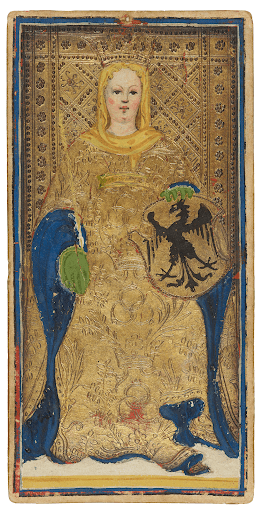
The Empress by Bonifacio Bembo. Source: The Morgan Library & Museum.
The Wilton Diptych. Source: National Gallery, London.
The Evolution of Tarot Art Styles
Historical Foundations and Influences
As mentioned, the Rider-Waite-Smith tarot completely revolutionized tarot, as the way we give meaning to each card is heavily influenced by the deck illustrated by Pamela Colman Smith.
This deck uses a set of colorful and unique pieces to convey messages meant to be deciphered by the interpreter. Everything, from the color, the direction the character is facing, the clothes, the environment, each plays a part in the interpretation of these divination tools.
The style of the cards is mostly influenced by the Art Nouveau movement, albeit in a simplified form. It features organic elements, intense colors, and asymmetry. This modernist approach, combined with the historical elements represented in the characters’ clothing, provides this sort of timelessness to the imagery.
In this era there would also be developed decks like the Thoth tarot or The Book of Thoth, illustrated by Lady Frieda Harris and instructed by Aleister Crowly. Published in the 1940’s, these cards are renowned for their unique style, which blends elements of the Art Nouveau and Art deco movements, characterized by its bold lines and shapes, vibrant colors, intricate patterns, exaggerated ornamentation, along with fluid lines and organic forms.
Another well-known deck from this period is the Lenormand tarot, which originated in the 18th century and is based on playing cards from Germanic countries. Although Lenormand is primarily recognized as an oracle deck rather than a traditional tarot deck, it remains popular for its distinctive approach.
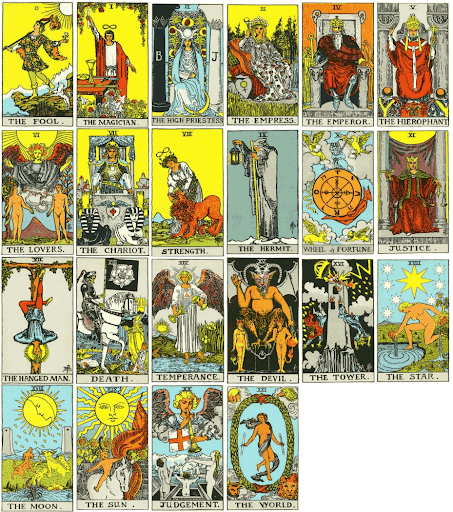
Major Arcana of the Rider-Waite-Smith tarot by Pamela Colman Smith. Source: Occult Encyclopedia.
Contemporary Tarot and Modern Interpretations
Currently, in a more technologically advanced world, digital art has made it easier for different artists to capture their vision into virtual spaces, and as such, many modern cards have been published independently. These new decks take multiple artistic expressions like the use of collage, mixed media, and art styles including minimalism, pop art, and even kawaii.
Contemporary tarot can also be a way of constructing meaning and exploring social issues, diversity, and identity. For example, the Everyday Witch tarot, illustrated by Lisa Sterle, takes the symbology of the Rider-Waite-Smith, and transforms it into a modern, women-oriented retelling of the same narratives, utilizing a diverse array of characters that replace the originals.
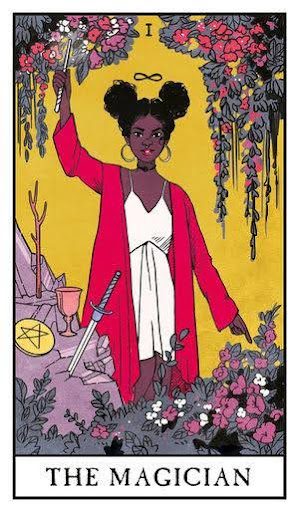
The Magician in Modern Witch tarot by Lisa Sterle. Source: lisasterle.com
Lastly, if you’re interested in tarot as an artistic expression, count yourself lucky—today there are more decks than ever, with many versions being produced every day. Say, for example, you like old sitcoms: the Golden Girls tarot or the Friends Tarot could be of your interest. Or, you’d like to immerse more profoundly in the mysterious and occult side of divination: the Santa Muerte tarot or the Occult tarot could be more fitting.
Symbolism in Tarot: A Visual Language
As noted earlier, tarot, particularly the RWS tarot, relies heavily on symbolism to convey its messages and meanings. Additionally, tarot can be viewed as an art form that is closely tied to narration and storytelling. Each card, as well as the combination of multiple cards, can create narratives that seek to provide insights into the past, present, and future.
But how does tarot convey stories through its inherently visual nature? Let’s take, for example, The Fool.
Numbered as 0 in most tarot decks, The Fool is the first card of the major arcana. As an archetype, The Fool embodies a youthful, adventure-seeking character who is eager to take risks. The card typically depicts The Fool as either a beggar or a jester, or a mixture of both.
Taking from the RWS tarot, The Fool is a young man taking the first steps into a new adventure. We don’t know where he is headed or why, but he is walking anyway. Positioned at the edge of a cliff, he remains unconcerned about the potential dangers. His posture radiates confidence and a carefree spirit.
The background is a bright day with a yellow horizon, representing the positivity and happiness that follows him. The white sun is a pure soul that shines through, the mountains the elevated spirit that awaits him at the end of his adventure. Next to him is a dog, the loyal companion that walks alongside him. All of this underlying narrative is encapsulated within a single card.
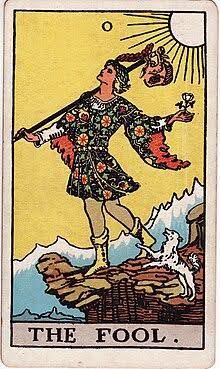
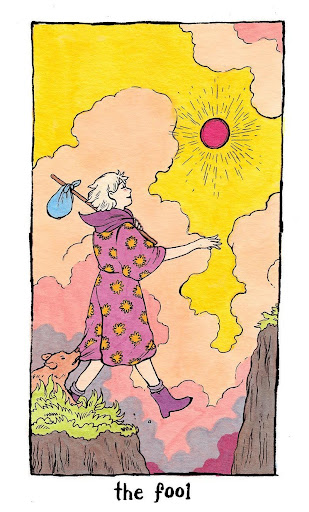
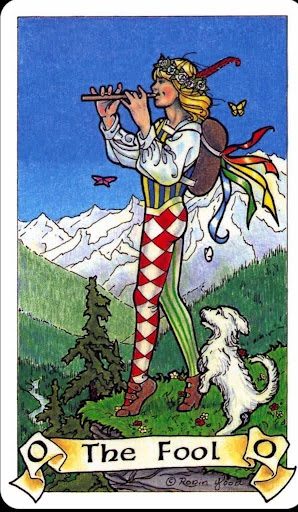
The Fool in the RWS tarot by Pamela Colman Smith, Cosmic Slumber tarot by Tillie Walden, and Robin Wood tarot by Robin Wood (respectively).
Other artists, such as Tillie Walden, reinterpret this archetype by telling a different story. In the Cosmic Slumber Tarot, Walden introduces the deck with a young person on the verge of falling off a cliff, while their companion—a brown dog—tries desperately to stop them. This protagonist is so captivated by the passionately red sun above that they are oblivious to the danger below. Unlike the RWS version, this depiction of The Fool is more likely to encounter tragedy, as it seems to lack any solid ground beneath them.
In contrast, the Robin Wood Tarot portrays The Fool as a happy, charismatic, fun-loving young man who is more attuned to his surroundings, embodying a sense of harmony with his environment.
These decks thus completely reinterpret the meaning of the card and its possible interpretations based on their distinct depictions. Tarot is a language, a text conformed by visuality, where the different symbols are the words, the cards are the sentences, and the spread is the conversation that guides the communication between the interpreter and the consultant.
Conclusion: Tarot as a Living Art Form
Tarot possesses a timeless quality as both a visual and symbolic system, where artists innovate upon its aesthetic elements while preserving the core essence of the practice.
However, I’d argue that tarot’s true power lies in its ability to use the represented archetypes as mirrors, allowing any person to see themselves reflected within the cards. For instance, I once had a client who asked about his dog; when he drew The Fool card, he exclaimed, “That’s me and my dog!” Each card represents a piece of a larger puzzle, collectively constructing a narrative for the consultant.
What fascinates me most is that every aspect of the consultation is translated into symbols that are relevant to the consultant’s needs. For example, if I were to draw two cards regarding a client’s finances and I pulled the Five of Pentacles (indicating poverty or loss) followed by the King of Pentacles (representing wealth or authority), I could interpret their relationship in various ways. While the straightforward reading might highlight a duality between financial struggle and abundance, I could also weave a narrative around these cards. The King, looking away from the Five, could suggest that the client is willfully ignoring their financial hardships to maintain an appearance of control over their wealth.
Thus, while tarot is inherently artistic and communicative, the practice of reading the cards becomes a unique art form in itself. It involves taking archetypes and universal symbols and arranging them into a story that aids the consultant in self-reflection and discovery, bridging both secular insight and mystical exploration.
Tarot has depth and variety which allow us to explore ourselves in a deeper way—not only as a divination tool, but also a piece of art with rich history and deep meaning ready to be interpreted.
Catalina Jahnsen
AUTHOR
Catalina is a scriptwriter, researcher, and communications professional with experience across the media landscape. A true jack of all trades, she has dedicated herself into various facets of the creative industries. Her journey reflects a passion for storytelling, a scholar perspective, and a deep bond to media and arts.
 Culterate Blog
Leave a comment