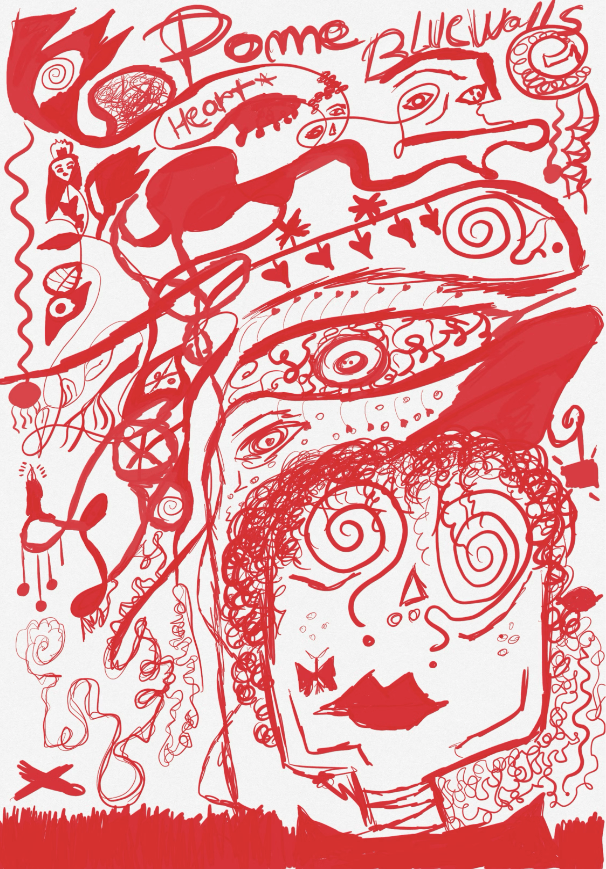
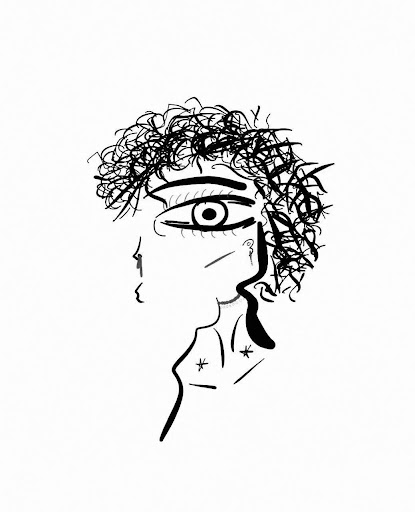
Blue Walls is a 19-year-old Lebanese writer and artist currently based in France for his studies. His work bridges poetry, philosophy, and visual storytelling, weaving raw emotion with a meticulous artistic vision. Deeply influenced by identity, mental health, and the fluid nature of human experience, his poetry crafts immersive worlds where language serves as both sanctuary and defiance.
Drawn to creation from an early age, he has always been writing, shaping, and imagining. His latest work, Pomegranate, is a quartet of poems that navigate darkness, sorrow, eroticism, and light offering an unfiltered exploration of emotion and existence. His writing is both intensely personal and universally resonant, inviting readers to see themselves within his words while inspiring them to carve out their own artistic space.
For him, art is not just an outlet but a necessity an ongoing dialogue with himself and the world. Through poetry, he challenges silence, breaks boundaries, and seeks liberation in expression.
Moara Flausino
INTERVIEWER
Moara is a journalism student from Brazil with a passion for literature, poetry, and art. Since 2021, she has been working in writing and content creation, and she has two poems published in anthology books of poetry. Learning new things excites her, and she believes that embracing different forms of writing and expression is always inspiring. Her goal is to write as many stories as she can, sharing their uniqueness with the world.
M: Can you start telling me a little bit about you? What do you do, what are your interests, since when do you write poems and how did you first start writing them?
B: I’m a 19-year-old writer from Lebanon, currently in France for my studies. I’ve been writing since I was very young probably around 7 or 8. I had this Spider-Man agenda my mom got me, but instead of using it for homework, I filled it with stories and drawings. Poetry came a bit later; I had always written bits of it, but I started taking it seriously in 2020. My first poem, if I remember correctly, was called Boxed Room. I later began sharing my work online after writing My Pet Fish Died, which was the first poem I wrote for Blue Walls.
M: Let’s talk about your poem ‘Pomegranate’, which symbolizes both wound and remedy, as you wrote on your allpoetry.com page. First of all, this is a very deep and meaningful poem. The rhyme is notable and the references bring us closer to the Picture you want to portray. I would like to know how was the process of making this poem. What did you consider for the word choices and the ambiguous point of view of resistance and surrender?
B: I always wanted to write a poem called Pomegranate, so I wrote the title in my notes and left it there for a while as I worked on other things. Then, one night around 2 AM, I was scrolling through my notes and found it again. I started balancing words, shifting them left and right, almost like arranging pieces in a puzzle.
The vision for the poem felt like a painting I kept seeing angels and grapes for some reason, everything that reminded me of mythology. I also knew that I wanted this poem to be part of a body of work, not something I’d release on its own. So, in a way, putting all of this chaotic imagery together felt like mixing the colors of a rainbow, only to end up with this greyish-brown finish a blending of emotions, ideas, and contradictions.
M: In ‘Harp Body With Lips’, we read a very sensorial poem, filled with words and verses that capture movements of the human body and also sensations of it towards love. I would like to hear from you what you think about love and how our body changes when we’re loving or in love with someone.
B: Love is something really beautiful to me. I’ve been in love with a certain person, and in fact, Harp Body With Lips was about them. Writing this poem was a strange yet sensational experience I’ll never forget the rush I felt while working on it. It’s probably the poem I felt the most while writing.
For me, when we’re in love, our bodies start to vibrate to the frequency of the other person. There’s harmony when both people are in sync, moving at the same tempo. Love, in its essence, feels natural and deeply human, but maintaining it is crucial. It’s also fragile I’ve learned that from past experiences, but that’s a conversation for another time.
M: ‘Heart Roots’, as you also shared on your allpoetry.com page, is a poem about your nation and how the tense political atmosphere impacts innocent lives, such as children, who you mention in your poem. For you, Blue Walls, how does art endure even in difficult times?
B: Everything happening in the world right now is terrible, and in times like these, art becomes a form of protest. It’s one of the strongest ways to make our voices heard. Art is political it doesn’t exist in a vacuum; it moves with time, reflecting the struggles and hopes of its era. Keeping our heads up and continuing to create is necessary. I truly believe that our generation will be the reason for change, for breaking outdated political ideologies and shaping a better future.
M: Your last piece from your poetry quartet, ‘Cherry Juice’, is dramatic and very intense, showing a sense of loss and also a request for relief. Which part of this poem do you think is the most representative of the message you wanted to say? Is there a specific choice for the fruit cherry?
B: Cherry Juice went through a lot of changes before it became what it is now. Initially, it was longer and more complex in terms of language, but I refined it to focus on the core emotions. The poem is about descending into hell but still searching for light, which is something that applies to life finding hope even in the darkest places and times.
The line ‘I climb mountains, not with a wooden cross, but with a basket of cherries held in my palms.’ represents this idea the most for me. It contrasts the burden of suffering with the act of carrying something delicate, like cherries symbols of both sweetness and fleetingness. I structured the poem into two parts: one that embodies darkness and another that leans toward hope.
M: Your Pomegranate poetry quartet brings different emotions about suffering, but also about surviving. How do these emotions affect your art and your life in general?
B: My art and writing are deeply connected to what I feel and experience in life. My emotions are the main source of my creative energy. In Pomegranate, I encapsulated half of the emotions I had been bottling up for a long time—feelings that, even today, I still carry heavily. Writing these poems was a way to process them, to give them shape, and to make sense of them in a way that I couldn’t otherwise.
M: Blue Walls, do you have artists who inspire you and keep you active in writing and talking about your deep thoughts, your emotional experiences, and your perspective about the difficult moments we go through in life, whether it is on our personal lives or external facts, like the war?
B: I tend to draw more inspiration from musicians than writers. If I had to name a few, I’d say Ethel Cain and FKA Twigs they both have some of the best pens of our generation, in my opinion, and their lyrics resonate with me deeply. Their ability to weave storytelling, emotion, and atmosphere into music is something that really fuels my own creative process.
When it comes to writers, I find a lot of inspiration in French poets like Charles Baudelaire. Lately, I’ve also been exploring the work of Dylan Thomas, whose writing has been a new source of inspiration for me.
M: If you could share a message with the world, what would it be?
B: Something I always say and try to apply to myself, especially as an overthinker, is: Get out there and take a deep breath. As humans, we tend to complicate things more than they actually are. Sometimes, all we need to do is step back, breathe, and remember that every wave will eventually pass.

 Culterate Blog
Leave a comment