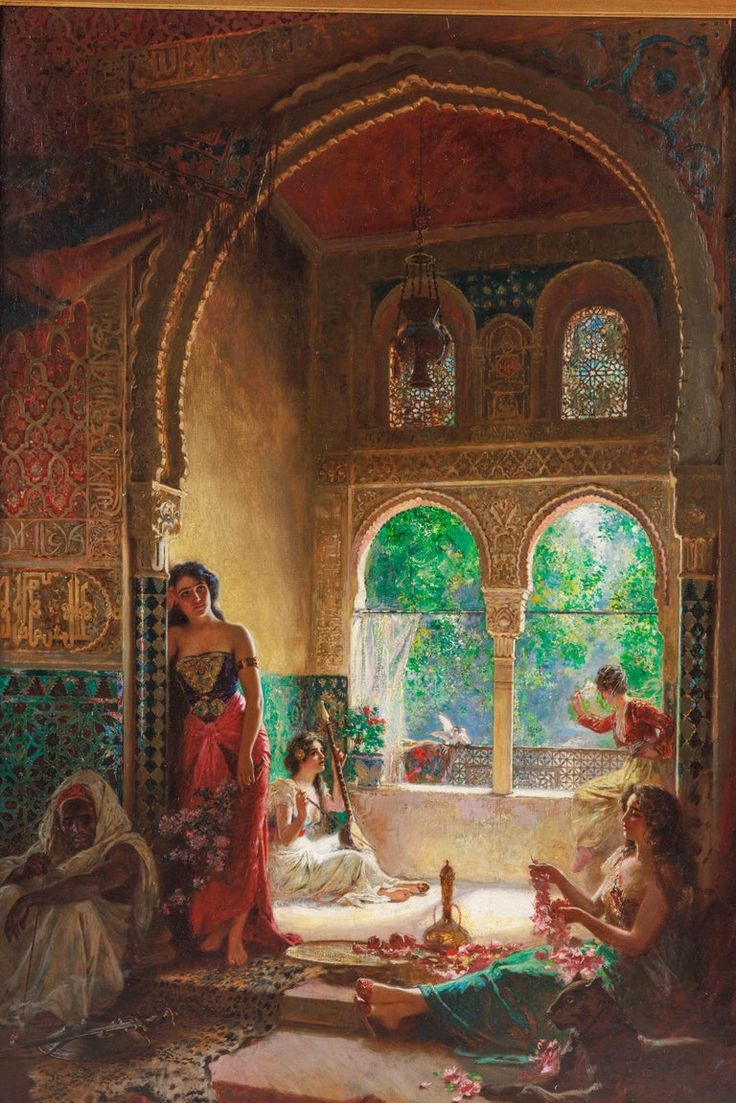
19th Century Italian Orientalist Masterpiece Painting “Four Women In The Harem”
c. 1880, in the Circle of Rudolf Ernst.
Have you ever looked at an old painting of a lavish palace, veiled women laying on silk cushions, or mysterious desert landscapes and thought, “Wow, so magical”? You’re not alone. Orientalist paintings, especially those from 19th-century Europe, were designed to dazzle the viewers, but beneath the surface, they tell a much more troubling story.
These artworks weren’t just about beauty or cultural fascination. They were part of a much bigger narrative—one that helped justify colonialism by portraying Eastern cultures as exotic, backward, and in need of Western control.
What Exactly Is Orientalism?
The term “Orientalism” was popularized by scholar Edward Said, who pointed out how the West (mainly Europe) created a romanticized and often inaccurate image of “the East”, including the Middle East, North Africa, and parts of Asia. In art, this meant turning real people and places into fantasies.
Artists like Jean-Léon Gérôme, Eugène Delacroix, and others painted scenes of harems, markets, and desert life, gaining fame for their romanticized portrayal of Eastern culture.
Many had never even visited the places they painted; or if they did, they viewed them through a colonial lens. Instead of capturing the complexities of local cultures and presenting them from a fresh perspective, they cherry-picked the most “exotic” elements, filtering them through a Western imagination. The result? A seductive but deeply distorted image of the East.
The Problem with the ‘Exotic’
At first glance, Orientalist art might just seem like a celebration of different cultures—full of rich color, ornate detail, and dramatic scenery. But the issue is that these works often stripped people of their humanity and turned them into props in someone else’s fantasy.
Women were usually shown as passive, hyper-sexualized figures—lounging in harems or bathing, always available for the viewer’s gaze. Men were depicted as either violent warriors or mysterious merchants. Everything was over-dramatized to fit Western expectations of what the East should look like.
It wasn’t representation, it was performance.
Art as a Tool of Empire
What makes this even more troubling is that these images weren’t just harmless fantasies. They were created during a time when European powers were actively colonizing much of the world, including many of the regions being depicted.
By showing these cultures as strange, wild, or uncivilized, Orientalist paintings subtly reinforced the idea that colonization was necessary—that the West had to “save” or “civilize” the East. In this way, art directly or indirectly became a part of the propaganda machine; being used by colonial powers to justify the atrocities and control of the Middle East and North Africa.
Rethinking the Past
Today, many museums and galleries are starting to reconsider how they present Orientalist works. There’s a growing awareness that while these paintings may be technically brilliant, they also carry a heavy legacy. Some institutions now include more context about the colonial history behind the art, while others are working to amplify voices from the cultures that were misrepresented.
And artists from the Middle East, South Asia, and beyond are responding—creating work that reclaims their stories, challenges stereotypes, and flips the colonial gaze.
Orientalist art reminds us that even something as beautiful as a painting can carry deep biases. But by looking closer and questioning what we see, we open up space for more honest, inclusive, and empowering narratives in art.

Mahnoor Tariq
AUTHOR
Mahnoor is a writer and designer with a deep passion for art, culture, and storytelling. She is dedicated to exploring overlooked narratives and bringing unique perspectives to light. Creativity is the driving force behind her work. When not writing, you can find her drawing, exploring new ideas, and immersing herself in the world of art.
 Culterate Blog
Leave a comment