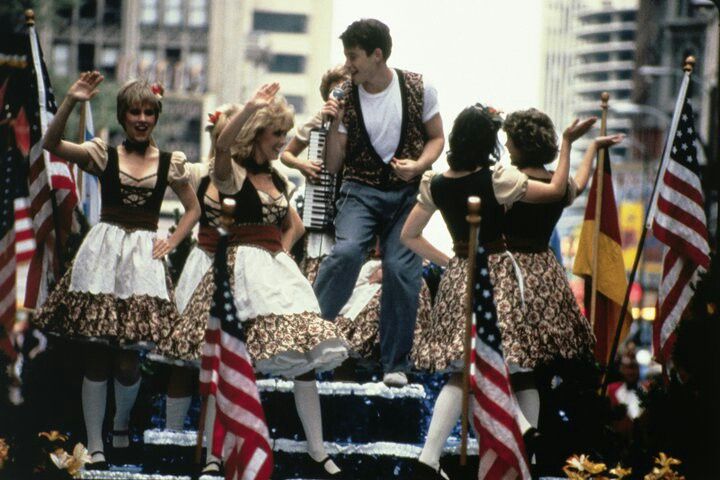
Ferris Bueller’s Day Off (1986)
If someone asks you what movie comes to mind when you hear the songs listed below, what would it be?
“My Heart Will Go On”, by Celine Dion.
“Take My Breath Away”, by Berlin.
“Eye of the Tiger”, by Survivor.
“I Will Always Love You”, by Whitney Houston.
“(I’ve Had) The Time Of My Life”, by Bill Medley and Jennifer Warnes.
“Stayin’ Alive”, by Bee Gees.
“You’ll Be In My Heart”, by Phill Collins.
“Twist And Shout”, by The Beatles.
The list could go on. You might not know every artist, but if you play just 30 seconds of each song, odds are you’ll picture these films: Titanic (1997), Top Gun (1986), Rocky (1976), The Bodyguard (1992), Dirty Dancing (1987), Saturday Night Fever (1977), Tarzan (1999), and Ferris Bueller’s Day Off (1986).
These movies each portray different plot, characters, tones. But what ties them together in our collective memory is their unforgettable music.
Psychologists suggest this connection is rooted in how our brains respond to sound. A 2010 study by the University of California showed that humans are as sensitive to sound cues as certain wild animals, demonstrating its significant emotional influence on our connection to movies.
A song can evoke a range of emotions. It can make you feel sad, reflective, energized, relieved. It complements scenes and sometimes even enhances the dialogue or monologue.
Take Ferris Bueller’s Day Off. There’s a famous scene where Ferris grabs a mic during a parade and starts singing “Twist and Shout” – The Beatles. If you know the song, you’d probably hear in your head a certain catchy verse: Come on, come on, come on, come on, baby now (come on, baby) / Twist and shout (twist and shout) … The song is a perfect choice for the scene, and for Ferris. He is fun-loving, rebellious, carefree – a comical teenager just looking for fun. An energy which is perfectly captured simply by playing this song. Hearing it is like seeing young people dancing the ‘twist’ (a popular dance move in the ‘60s that had nostalgic resurgence in the ‘80s) or like watching Ferris hop onto a parade float in downtown Chicago, waving his arms, lip-syncing with joy, while the crowd joins in. Spontaneous, bold, and unforgettable, like Ferris himself.
This is just one famous example, but the truth is a well-placed soundtrack can elevate any genre. Musicals rely entirely on song, but non-musical films can use music just as effectively. It’s all about the right timing, the right lyrics, and the right emotion.
Unpacking the broader impact of soundtracks
If you think about famous soundtracks, especially those you love, you might say, This song never gets old. That’s not just nostalgia or the fact that music transcends time, but also because a powerful soundtrack can enhance a film and garner attention.
Consider the legendary James Bond series. The films capture attention not only for their action scenes but also for their memorable music, which serves as a theme for each installment. Adele, Billie Eilish, Sam Smith are among the most recent artists to perform the main songs for the series, and as the films became known for their powerful songs and singers, the opening sequences evolved into more complex and lengthier music videos.
We have two interesting perspectives here, following James Bond’s example:
1 – The movie soundtrack is a vital part of the story; the song and lyrics connect deeply to the main character and their new adventure in each film. This offers a chance to tell the story in a different way, adding more depth and connection between the audience and the film.
2 – Alongside the storytelling aspect, we can see how a soundtrack promotes a film. For Bond, it has become a tradition to include a main song that encapsulates the plot of each movie. This creates curiosity about who will be the next artist to sing the main theme; audiences would wonder, which singer will be the voice of the next James Bond movie? even before the current one is finished.
This elevates the soundtrack to a new level: music becomes part of people’s memories. Remember the songs listed at the beginning? They illustrate how vividly they can endure through time, irrespective of how many years have passed. They attach themselves not only to your intellect but also to your emotions, as the movie captures your heart, creating lasting memories that evoke the best scenes while you listen.
When you fall in love with a song because of its movie
Just like “Twist and Shout” in Ferris Bueller, soundtracks can bring old songs back into the spotlight. A recent example is Stranger Things. In its fourth (final) season, there is a striking scene where Max runs away from Vecna while “Running Up That Hill” by Kate Bush plays. The track, originally released in 1985, suddenly topped charts again, decades later.
What’s very interesting about Stranger Things is that it’s set in the 1980s, while airing in the 2010s and 2020s. This creates a fascinating contrast between a completely different world shaped by technological advancements and pop culture. Audiences today – especially younger viewers – may not have known Kate Bush, but the show reintroduced her music to a new generation.
Soundtracks like these forge emotional connections across time. Someone born in 2002 might never have heard “Should I Stay or Should I Go” or “Running Up That Hill” without Stranger Things. For those who were teens in 1985, the same songs bring back memories of their own youth.
Conclusion
I may not be an expert in music or musicality for cinema, but it’s impossible to not recognize how important music is for a film. We saw a lot of examples here, from Titanic to Dirty Dancing to Stranger Things to Rocky, but I’m sure that you have another song in mind from some other movie or series that you really enjoy that could make the list.
The point is this: a good song can make a story unforgettable. It creates a lasting connection like an invisible string between the screen and the audience.
 Culterate Blog
Leave a comment